


Research released by Ahrefs (AI Overviews on Branded Searches) caught our eye last week. In an independent user test, 93% of 100 branded searches in the US triggered an AI Overview, across a mix of large enterprise brand searches and small businesses. Ahrefs validated the findings and ran the test at scale, analysing 232.8mn brand searches since July and found similar results landing at 83% in September. This was at 61% in July, so a huge acceleration noted.
With no UK stats out thus far, we ran our own incognito test on desktop to assess risk with peak season looming.
Method
- Trigger the same pure brand search 100x for two different brands – both D2C – one Beauty and one Apparel
- Trigger the same brand product search 100x for two different brands on their highest SV BP term
Measurement
As AIO’s can appear anywhere on the results page, we counted the position of the AIO per search conducted, in both pure brand and brand product arms. Position is important for this study due to brand PPC CTR most likely to be threatened when an AIO is top or absolute top of page.
Results
There is a distinct difference in results between the beauty and apparel brand.
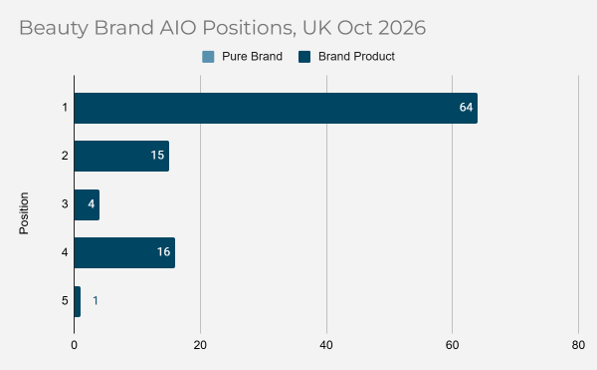
Fig 1: Count of AI Overview result by position for pure brand and highest SV brand product term for a mid-sized global cosmetics and skincare brand with a significant UK footprint
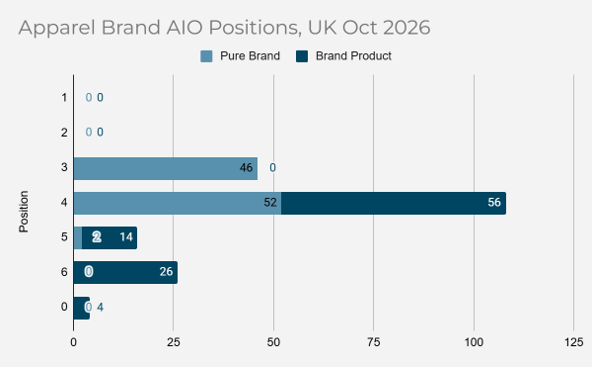
Fig 2: Count of AI Overview result by position for pure brand and highest SV brand product term for a medium-to-large multinational clothing brand with a medium-sized subsidiary in the UK
For now, the impact of AIOs on paid pure brand results will be negligible in the UK – but following the testing of AIOs in prime top positions for brand product may warrant a pure brand shift closer to next year. For the apparel arm of the test, position 1 and 2 on pure and brand product searches did not surface an AIO so likely no impact on CPCs or CTR threat over here from a brand perspective.
But here is the crux of the study….
Brand product in beauty is severely threatened, especially for high search-volume, trade-driving searches from users with product familiarity and ready to purchase. In 64% of searches in our test, the AIO was in top position, sitting above PLA. 15% of the time, the AIO was in the position just below the PLA. 83% of these searches triggered an AIO before the first scroll, so this top of page is heavily impacted. Our results matched precisely to the US large-scale Ahrefs test!
Looking more deeply into the Google Ads data for this keyword, we can see that CTR for this term is the lowest it has been in the 12M period since September 2025, hitting new lows of 10% in the last three weeks versus this averaging 20-25% usually. Bidding strategies, ad strength and landing pages have been unchanged in this period; in fact promotions should have boosted the CTR – but the data matches up with our AIO Positioning study. 64% of searches saw AIO at the absolute top and we are seeing that loss in paid Abs Top % for the same keyword and a low CTR. This is a petrifying shift once applied at scale across all our brand product bidding inventory.
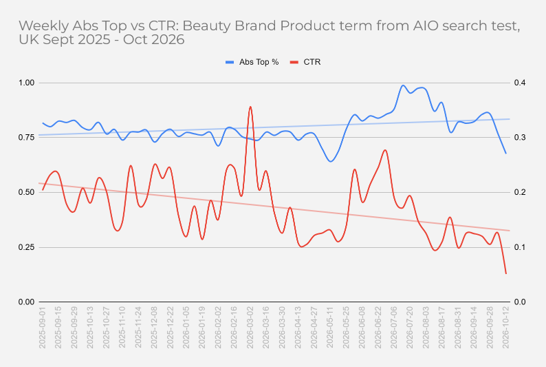
Fig 3: Weekly Abs Top & CTR for exact variant of top SV brand product term, Last 12 Months, Google Ads. A significant drop observed for September aligning with the release of enhanced brand AIO’s in position 1 in UK
While nonbrand expansion in both traditional and AI search across organic and paid placements will remain a key narrative to uncap net growth, it should no longer be the only growth narrative – especially in the Beauty vertical! In addition, an emphasis on an alternative definition to brand defence, should focus on a blend of AI and traditional search format defence, with dashboards to match. We’ve all been there, in the trenches, obsessing top of page rate for brand terms, and we all empathise within the industry over countless times Google has changed their rules – is it the highest bidder, the advertiser who opts into AI Max on brand (excuse me, Google?), or the most relevant ad which is the greatest ranking lever?? Now with AIO’s heavily present on brand results, the top of page will no longer be the golden egg for PPC.
Timing couldn’t be better… with peak season around the corner and now a huge grey cloud of ambiguity hanging over brand PPC retail brands in US and UK will certainly struggle to match their YOY brand search campaign revenue with clicks lost to AIOs. While this has been a small scale test on just two of our clients, we will stay alert to larger-scale studies across a wider set of verticals.
So, what now?
- Client education is first. With peak forecasts likely already shared with ambitious YOY growth to hit, we should be influencing clients to evaluate total search revenue rather than ‘by line’, as the YOY SERP landscape is not identical on brand. If your client does not have the appropriate SSOT revenue tracking for both traditional and AI search sources, now is the time to close these infrastructure gaps
- Set up CTR vs Top of Page / Abs Top dashboards (possible in Google Ads) to spot anomalies and drops emerging on paid branded impressions. Understand that CPC is unlikely to influence ranking, and engage SEO / GEO teams for AIO impression tracking and brand voice management
- Is brand incrementality or geo holdout on your roadmap? You may need to rethink these. The SERP, specifically the presence or top ranking for brand, is not replicated for every search. For some time, the SERP has been AI-Organised, but now the enhanced AIO presence on brand makes incrementality difficult to measure. Total search reporting and connected commerce measurement frameworks will be more worthwhile
- From a GEO perspective, while brand optimisation has always been part of the roadmap, the new threat from this update is that competitors and external sources can now control the narrative of your brand granted there are enough high authority and relevant citations. Keep an eye on brand AIO results with regular audits to own this space where PPC has been bumped down the page
Closing thoughts which now keep me up at night:
Is this the end of the auction?
With clicks set to reduce on high investment campaigns, has Google’s business model moved closer to LLM monetisation and user retention over advertiser CPCs?
Will our Google reps be cognizant of this change or continue to push our CPCs? Will the platform even recognize these drops in context or tell us to increase our budgets?